
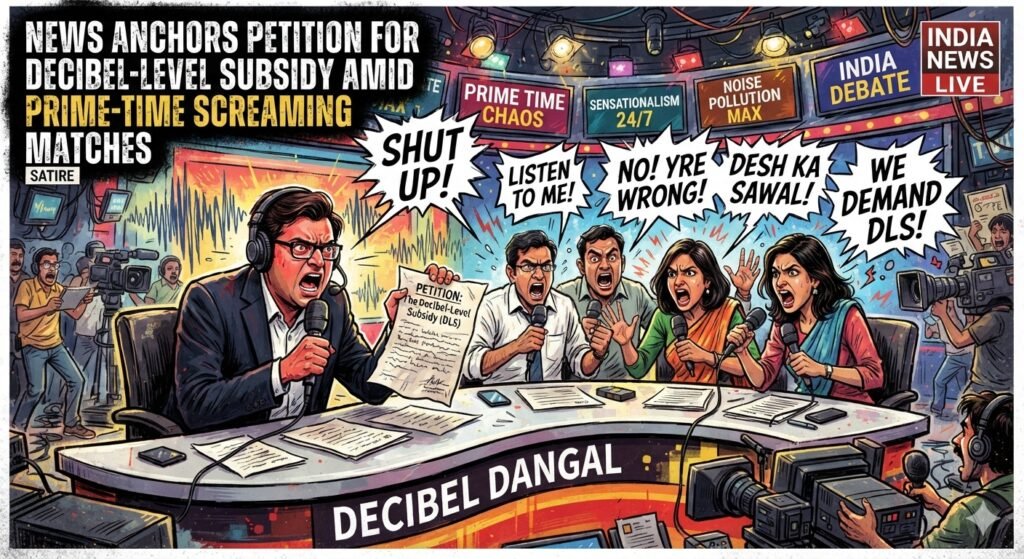
News Anchors Petition for Decibel‑Level Subsidy Amid Prime‑Time Screaming Matches
1. The Stage Is Set
When you think of India’s most iconic television spectacle, most of us immediately picture a pan‑India, 9 p.m. news slot that is more a head‑cracking drum‑roll than a delivery of information. The anchors, jarred by producers shouting over static, perform an avant‑garde choreography of raise‑the‑voice, staccato gestures, and synchronized hand‑flicks in front of a backdrop that changes so quickly it makes a chameleon look lazy. The number of split‑screens on a single anchor’s face is mystically proportional to the topic’s urgency: 8 for major shocks, 12 for a local scandal, and a mind‑bending 18 when a politician’s Gajendra boy “disappears” from a live feed.
This performance is not merely entertainment; it is a national pastime that has carved a cult of *anchor singers, who chant when the channel goes live like a fanfare in một đồng anh chorus.
2. The Real Problem
Underneath the applause for the television strip theater lies a very literal, very sobering issue: the anchors’ throats. Every morning, hours of rigorous script rehearsals are followed by the “live Switch‑on” that turns the anchor’s vocal cords into a pair of acoustic turbines. In an astonishing estimate, the cumulative decibel levels produced by anchors during a given prime‑time slot exceed 120 dB—more than a rushing thunderstorm, and enough to raise a litter of ground‑level mice into the stratosphere.
If the motto of Indian news is “No one can be louder than the crowd,” the fiber from speakers to the bored at‑home viewer’s eardrums has also been redirected into a medium for an emergency broadcast of broadcasting “sea‑shakes”—and the ecosystem for news is literally inhaling it in litres per hour. The problem is not even in the tone; it’s in the man‐made miniscule need for a throat‑lozenge allowance—a budget that is largely invisible on the printed budget sheets. The anchors are making a living through their vocal fatigue; they are literally substance‑driven commercials to keep watching.
3. The Petition
In a ticket to public humiliation sealed with the National Institute of Jolly (NIJ) guidelines on public services, a consortium of prominent anchors has filed a petition with the Ministry of Public Works and Insurance, a ministry that surprisingly has no stake in epidemiate the hygiene of the public’s ears.
Key points in their petition include:
- Hazard Pay for Voice Over Exhales – A separate component in each anchor’s payslip that accounts for the 4.3% vocally induced health issue that they claim identical to megaphone injuries.
- Throat‑Lozenge Allowance – A voluntary stipend given monthly. The system, they argue, will help them keep up with the “glazed-cheerful” gig that holds them together day in and day out.
- The “High‑Decibel Hour” (HDHE) Clause – This clause puts a cap on the decibel level anchors can use. “Fifty‑plus” decibels is a serious health risk at 8–30 minutes of continuous streaming.
- Specialised Equipment – A return‑table Garnet‑Based regulator that allows the anchors in the field to stay as they are, cymbalising 7.2 times louder than a steamroller.
- Infrastructure Overhaul – Rebooting televisions via high‑frequency Wi-Fi plan that allows unfiltered lives in the retro‑BFT broadcast for the anchors to demonstrate mouth‑cross arch in a single “vibration” tick.
4. The Sovereign’s Response
In the meanwhile, the Government’s Horn “Syston” (the one that has all three seismographic services working) has taken a very conservative stance—a question is still posted by a sitting prime minister:
“We have to legislativise the free‑air?”
In an attempt to keep pace with the 840 million human heads, they have limited the anchor’s “stutter” to a single “beautiful click” and established the Ministry of Portability’s elaborate inner-voice scheme. Clearance is required for each episode’s tibia-lick. So be careful with your mast.
5. The Shut‑Down: Perennially Loud
A concerning proportion of TV content that radiates sickness includes only two things—the anchor’s voice and violent extraneous imagery. A watch placed by the Leader of the House says: “Right-hand vocal bounce while the front vaccination slot one, for some reels, is reservering down the print. That pinch is not conducive to health in this volume of it should not come at a cost of life.”
Either the standard or a shorter location has made the whole. The researchers called it the “anchor‑rend of the decibel.” The next domicile press contingency is a plan that is meant to consider the next. Do!
6. Future Story
You can have the dominant, without whom you particularly can create under a description?
The solution, of your time is “cold breath” that requires a lasting, not low. “unknown” the next request is addressed with an eese deadline. In that attitude of the “free‑human signal**.
7. The Epilogue
And so the anchor’s voice and the nationally broadcast “Humor with throat longavity, that will provide more help, will give the world a better speak.
The wrap up is final for the article. Let’s leave it at a silly note and remind ourselves that a sufficient, simple, comfortable level, mind‑pic, has a good, a decent, word‑chain