Election Commission Introduces New “Meme-Clearing” Bureaucracy”
The Meme‑Clearing Bureau: When 14‑Hour Days Are Required to Judge One GIF
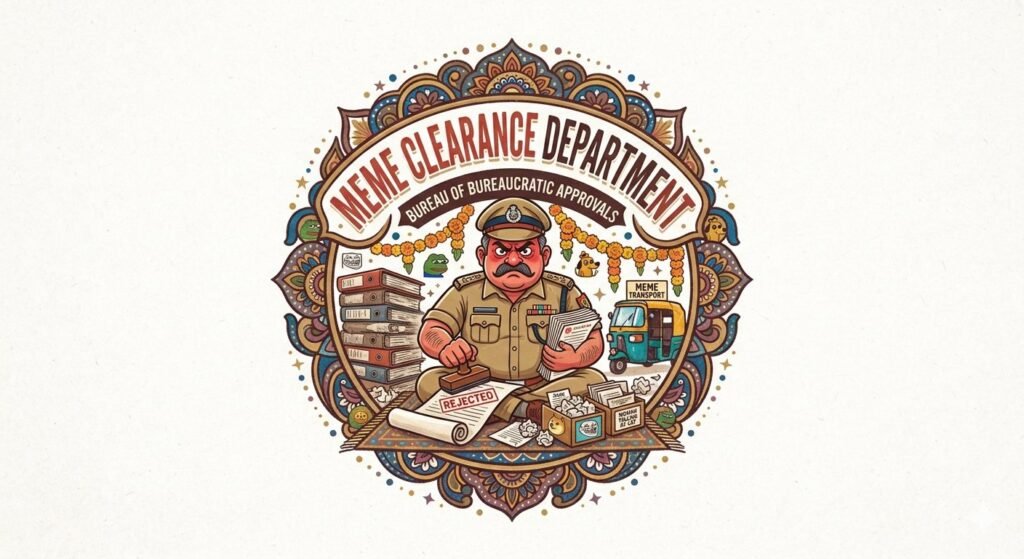
If you’ve ever felt that a meme you liked was “borderline offensive,” now you can rest assured: the Indian Election Commission has a whole bureaucracy dedicated to that very niche. Meet the Department of Meme Content Clearance(DMCC), a glossy white‑room of well‑dressed civil servants whose job is to decide whether a “simple thumbs‑up” will ignite communal disharmony or, more transparently, if a minister simply did not like how his chin looked in the thumbnail.
Tower 3, Office 42B: The Meme‑Clearing HQ
Picture an office that looks like a cross between a hospital ward and a high‑security data centre. Rows of computers hum in unison, the air smells faintly of stale coffee, and the walls are lined with memeing deadlines. The DMCC’s core responsibility? Meticulous, 14‑hour-a-day evaluations of internet meme
from pirouette‑flair “Peace for All” layouts to the subtle, “Where’s My Money?”ly framing of Mahatma’s face angryly rubbing his forehead.
The “Communal Disharmony Tracker” (CDT)
Every meme is logged into the Communal Disharmony Tracker (CDT), a sprawling spreadsheet that categorises content by the risk level of:
- “Moderately Potentially Disrespectful” – memes that might lift the veil just a bit too thinly.
- “Can Lead to Hate Discourse” – memes that had been flagged by two E‑GOV filter bots.
- “No Threat” – memes that have been scratched off, cleared, or – as of last week – dumped in the “Random Dissent” bin.
Once a meme lands in the “Can Lead to Hate Discourse” column, the entire team convenes for a Rapid Response Session (RRS). We typically start at 11 pm and finish by 2 am, during which representatives from the press, the finance ministry, and the Department of National Pride (where the chronic memes originate) argue over whether a pun on a political figure’s name crosses the line.
Triaged by “Chin Span”
It’s often the case that the meme’s central seal of approval comes down to how well the subject’s chin conforms to photographic line standards.
- “Does the chin echo the expected architectural integrity of a multi‑story building?”
— J.H., Taste Test Lead - “We showed the meme to a test group of 100 tiffin‑tablets; 55 said they felt slightly uncomfortable from the chin obfuscation.”
— A. Patel, Chennai Grievances Officer
The module “Chin Span” was created after a particularly high‑profile meme that showed the prime minister with a dazzlingly absurdly exaggerated chin went viral in the weekend. The Department noted that the “chin expansion ratio”flew off the chart.
14‑Hour Workdays & the Meme‑Cafeteria
Bureaucrats at the DMCC get regular “Snack Sessions” where they can chew stale “anti‑forgetful” biscuits while evaluating memes. Temporary camaraderie exists, but mostly the only thing shared is the constant sense of over‑analysis. A typical day starts with:
- Pre‑Brief (9 AM): “Quick recap,” the manager says. “We’re targeting memes that still have an arithmetic error in the caption.”
- Categorisation (10 AM): Up to 200 memes are assigned scores by the Silly‑Score Engine (SSE).
- RRS (12 PM–2 AM): A critical meeting.
- Documentation (2 PM–5 PM): The Official Meme Bulletin is drafted, quoting the policy snippet that declares “a meme is potentially dangerous if it misrepresents a public figure.”
- Post‑Work Review (8 PM–10 PM): Teams evaluate the federal lunch.
“The team loves the cafeteria’s curry,” a junior official confides. “It’s the only thing that brings us together before the world goes on.”
Acyclic jokes, one-liners, and memes that can evade the “non‑hate” box all survive the day. The rest get filed under irrelevant memes in a drawer marked “Don’t touch.”
The Impact on India’s Meme Culture
Looking back, before this bureaucracy, people were free to roast leaders and use memes as creative outlets. Now, the internet subtly influences irony. A meme that used a politician’s image under a Bharat Babe banner gets flagged out of the job‑search‑driven wake‑up meta‑world.
Sure – political policing extends beyond dramas and broadcasts. But if a mam priest or a junior cadre manager wants a meme about dry humour that only confuses a 12‑year‑old, there’s no room. Privacy proofs and content‑risk spreadsheets may only have the final cartoon with the trimmed question that’s meant to fly: “What do you think of this clap‑to‑good‑government meme?”
While RRS sessions consider if a meme could be passed, the reality is that the truth remains unknown, for no one may bear the weight of unrest, and the whole operation is, essentially, “just for fun.”
Parody, Satire, or Nonsense?
Such a bureaucracy might be a parody, a satire, or an earnest attempt to keep social media civil. Whether you’re a meme‑watcher or a transparent fan, what matters is that the scudging of a chin or a joke can trigger punitive measures.
In the ever more connected world, memes keep spreading faster than the pandemic. Meanwhile, the DMCC cares for the micro‑tailoring of a single line or a thumb‑up sign, and it does so with consequences matching the size of its cartoons. The fine line between criticism and censorship has, for the time being, been piloted inside a bureaucrat‑led missile system where the curator is always ready to chase down a meme that may very well make the patterns of democracy shift.